
A “bucket handle” tear is a serious type of meniscus injury occurring in the knee. Unfortunately, these typically require surgery. Let’s explore why.
What is a meniscus?
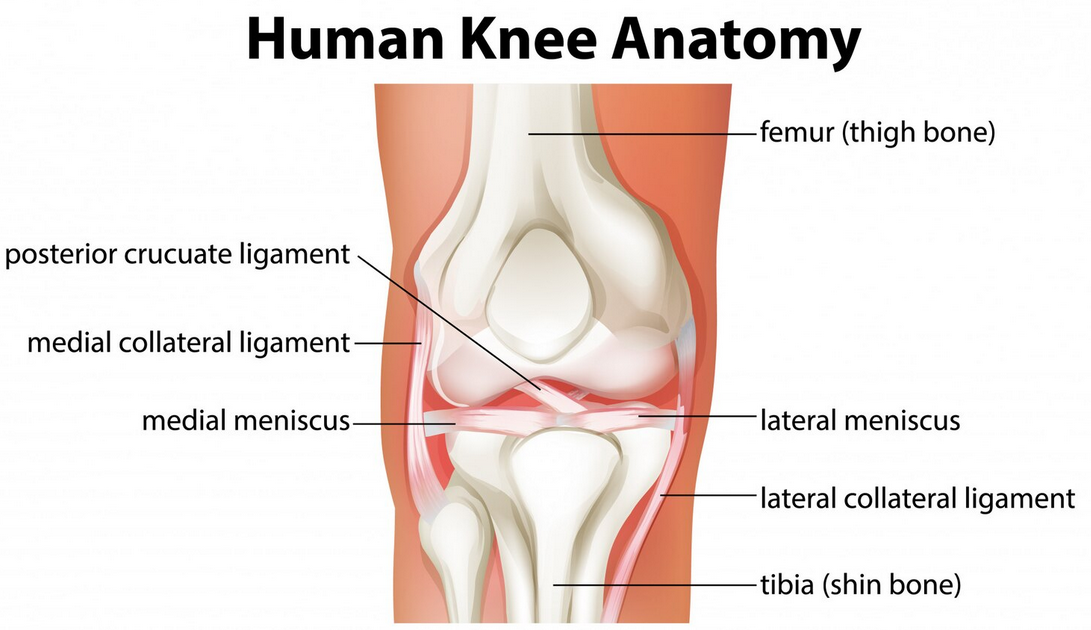
The meniscus (singular) or menisci (plural) are a pair of C-shaped cartilage structure which sits in our knee joints, between our femur and tibia bones.
There lies two menisci in each knee, the medial (inner) and lateral (outer) meniscus. The main function of the menisci is to absorb shock, making them an essential protector for our knees. For example, whether it’s a sport or just walking our menisci are helping to safely disperse pressure and prevent more delicate structures from getting injured.
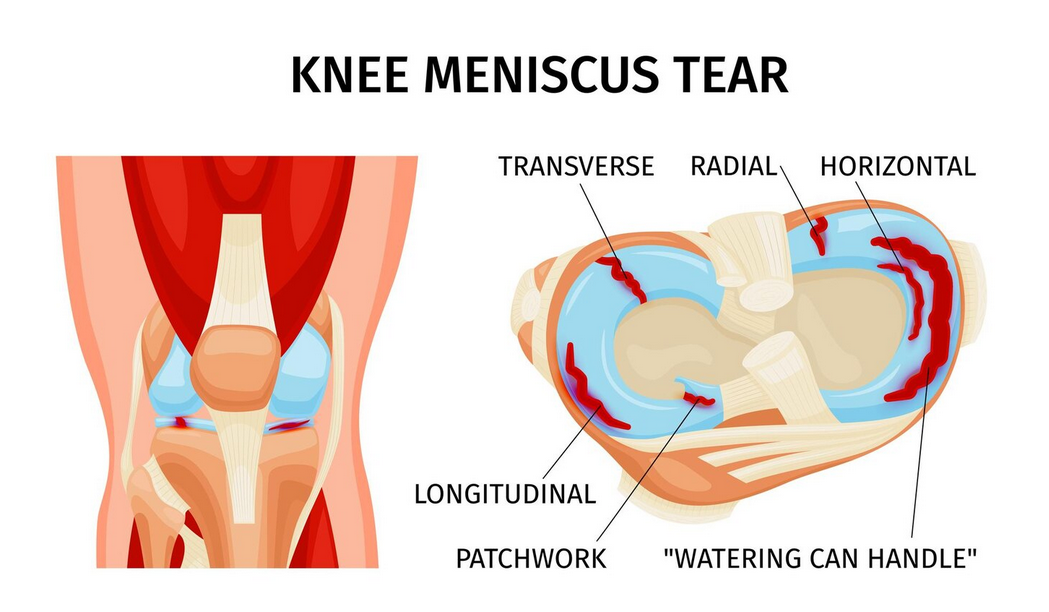
In a bucket handle tear (seen below, a large vertical section of the meniscus flips in towards the middle mimicking the motion of a bucket handle. This displaced fragment typically results in pain and an inability to fully straighten the knee. Bucket handle tears are most commonly associated with the medial meniscus and can also occur alongside ACL (anterior cruciate ligament) and MCL (medial collateral ligament) injuries. Altogether, these are known as the terrible triad.
How does a bucket handle meniscus tear get diagnosed?
First, the mechanism of injury will be considered. In most cases, the menisci are injured during these types of movements:
- Sudden twisting or pivoting on a planted foot
- Deep squatting with rotation
- From a contact sport
- Traumatic/impact injuries especially in younger athletes
Second, the signs and symptoms will be evaluated. Individuals will complain of or experience:
- Locking/inability to fully straighten the knee
- Clicking especially when trying to straighten
- Sudden pain
- Acute swelling (within first 24-48 hours)
- Joint line tenderness
- Feeling of instability
- Pain with twisting of the knee
Finally, if indicated, imaging will be used to determine the type and severity of the injury.
An x-ray will rule out fractures and ultrasound may only be able to detect large tears or extrusion of the meniscus peripherally. However, as a bucket handle tear would displace centrally, an ultrasound can miss the tear or displacement completely. An MRI would be the gold standard as it clearly visualizes the full meniscus and displacement.
What are other differential diagnoses?
Other common diagnoses with similar signs and symptoms may be a normal (non-displaced) meniscus tear or another form of loose body (ie. a piece of bone) stuck in the joint. While several knee injuries can share some of the above signs and symptoms, the main way to distinguish a true bucket handle tear is locking of the knee which rarely resolves without surgery.
What treatment options are there for menisci injuries?
Conservative treatment with physiotherapy will be the pathway for most individuals. The criteria for recovery without surgery are usually:
- Small, stable tears
- Degenerative tears, commonly >35 years old
- No mechanical locking and full range of motion
- Pseudo-locking of knee (reversible)
- Symptoms improving
The second pathway is surgical repair (arthroscopic surgery for a repair or meniscectomy).
- Population is usually younger, athletic patients
- Traumatic mechanism of injury
- True-locking (bucket handle tear) that does not improve conservatively
- Full extension can be achieved temporarily with manual therapy and movement but will redisplace
- Associated ACL injury
Arthroscopic surgery is minimally invasive surgery compared to traditional open surgery and has the benefit of faster recovery times, less post-operative pain and risk of infection, and less scarring.
What does the surgery pathway look like?
As mentioned above, there are 2 main types of arthroscopic surgeries:
- Meniscus repair – suturing of torn fragment
- Preferred when possible
- Best for younger patients, especially athletes
- Preserves meniscus leading to better outcomes for long term knee health
- Full recovery: 4-6 months
- Requires bracing in full extension and minimal weight bearing early on
- Takes longer and more precautions as sutured meniscus has to heal
- Partial meniscectomy – removal of displaced fragment
- Only if unable to repair tear
- Faster recovery but higher risk of arthritis in the long term
- Full recovery: 6-8 weeks
- Faster as no healing of tissue required
- Focus on strengthening immediately during rehab
John Hopkins offers a more detailed look into the procedure and what to expect here.
Either way, pre and post-surgical rehabilitation should be undertaken. Beforehand, maximizing the strength and stability of the joint results in a quicker recovery with less risk of complications. Afterwards, rehabilitation is necessary to ensure the joint heals well and to regain full mobility, strength and function. Without proper care after the surgery, the knee may not heal fully and will be limited in the tasks it can perform.
Looking for help with knee pain?
Whether it is a bucket handle tear and you’re awaiting surgery, or a more minor knee injury which can be managed conservatively, your physiotherapists at PhysioNow are here to guide you on how to best manage your injury. We have 10 locations offering sports injury physiotherapy, sports rehabilitation and post-surgery care across the west GTA. These locations include Burlington, Oakville, Mississauga, and Etobicoke. Book with PhysioNow today for your first assessment and treatment! Or reach us by email: applewood@physionow.ca or phone: 289-724-0448
Images by FreePik