
If you’ve ever felt a sharp, catching pain at the base of your thumb or along the side of your wrist when gripping your water bottle, holding a newborn, or lifting weights, you might be dealing with De Quervain’s Tenosynovitis, or some call it DQ for short.
This wrist condition is exceptionally common among athletes, manual laborers, new parents, and anyone who uses their hands repetitively. Let’s look at what’s happening inside your wrist, how to test for it, and how physical therapy can help you get back to normal.
What is DeQuervain’s?
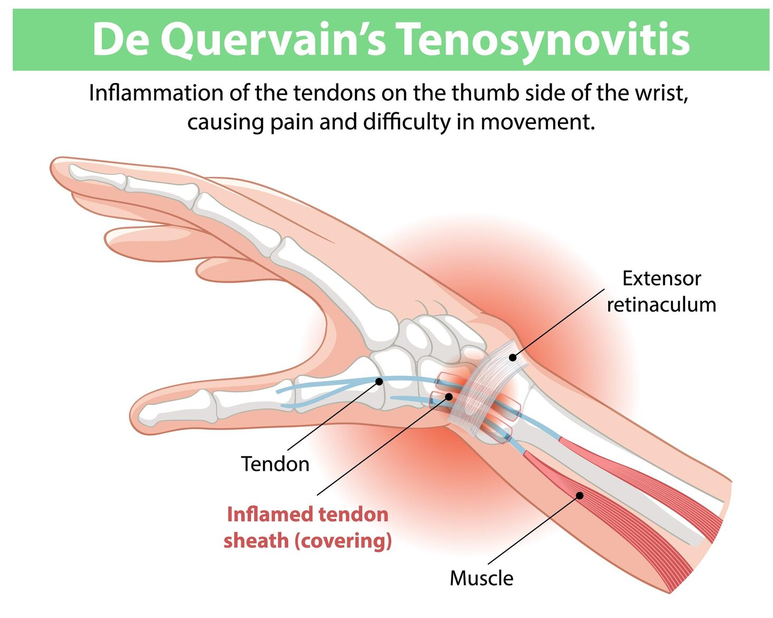
A quick anatomy lesson first. De Quervain’s is the inflammation of the tendons and the sheath they run through across the back of your thumb. Repetitive movements or even a consequence of an acute injury can cause the thickening and narrowing of the tunnel. Then, the tendons that normally slide back and forth in there have a higher chance of getting stuck, further worsening the inflammation.
The 2 muscles specifically that get stuck are called abductor pollicis longus (APL), and extensor pollicis brevis (EPB). Importantly, these 2 muscles give you the ability to move your straighten and move your thumb away from the palm and other fingers.
How do I know if I have DeQuervain’s?
Common signs and symptoms include:
- Dull or sharp pain at the back of the thumb, close to the wrist
- Pain worsens during gripping, lifting, twisting, pinching etc.
- Pain may radiate up the forearm
- Catching or snapping sensation when moving the thumb
- Swelling over the thumb area
Seeing a professional is the best way to diagnose wrist and thumb pain. There are several other causes of wrist and thumb pain and an expert Physiotherapist will be able to differentiate them. They will also determine whether imaging or medical intervention is necessary. For most cases of DQ, conservative treatment with physiotherapy has good outcomes.
How is this condition treated with Physiotherapy?
Physiotherapy is the first line of defense for DQ. Complete rest is never the answer, it will take a combined program of careful strengthening and activity modification to build an environment the tendon can recover in. Here are a couple of the topics and treatments that are likely to be part of your program.
- Splinting/bracing: Depending on which hand is affected, it can be very hard to avoid overusing it. A specialized brace called a thumb spica splint is very helpful to combat overuse. It immobilizes the thumb while leaving the other fingers free, giving the tendon a chance to rest. Depending on your individual factors, your PT may have you using it periodically during the day, only while sleeping, or a combo of both.
- Exercises: While small muscles, strengthening is a crucial part of any recovery program. Tendons do best when they are loaded, they need that stimulation to get stronger and more resilient. Your PT will you determine the right stage of exercises to begin with depending on your severity. They may also teach you tendon gliding exercises to prevent adhesions and scar tissue formation, improving the mobility of the tendons.
- Activity modifications: Your PT will help you determine aggravating activities in your daily life. Whether it’s changing your mouse and keyboard setup, a different grip in the gym, or a new way to hold your infant, there are strategies to minimize the strain of overuse.
- Manual therapy: Massage, soft tissue, and joint techniques may all be used to help pain relief, relieve scar tissue restrictions, and bring blood flow into the affected area. The specific techniques will be chosen based on the individual impairments seen in your assessment.
Can DeQuervain’s be avoided?

There are many tips and advice that can be followed to minimize the risk of developing an overuse injury like this.
- Lift with good form. The wrists should always be in neutral, not bent to the side or back. If you have a hard time with this, consider lightening the load or using wrist wraps to help.
- Take frequent breaks. If you have a repetitive job or a hobby, the tension builds up over time. Even if it’s as simple as keyboard and mouse work, frequent breaks every 30 minutes for 30s-1min can make a big difference.
- Use other muscles. Our hand and wrist muscles are relatively small compared to other areas. If possible, use different techniques that minimize gripping or pinching with your thumbs and fingers. For example, as physios we frequently use other body parts like our elbows or knuckles to apply pressure to save the strain on our hands.
- Identify early signs. If you already feel a nagging pain or ache, waiting and hoping for it to go away is not a winning strategy. The earlier you catch and take care of it, the easier it is to recover. Going to Physio early on can make the difference between a few weeks of recovery and minimal disability, or a few months of recovery and having to modify a lot of things in your life.
Looking for help with wrist or thumb pain?
Look for PhysioNow! We have expert Physiotherapist help across 10 West GTA locations. Come find us in Burlington, Oakville, Mississauga or Etobicoke! Don’t let your pain stop you from participating in your life, get started with recovery today. Book with PhysioNow for your first assessment and treatment.