If you’re awaiting a total hip replacement (THR), you probably have a lot of questions. Surgeries are nerve-wracking events, but the more you learn about a THR, the more at ease you will feel. Research and developments in the medical surgery field have made THRs easier than ever. If you’ve heard about previous surgeries you may have heard some scary things, spending long times in a bed or unable to move your leg in certain ways. Now, thanks to improved techniques and knowledge, movement and rehab start on day 1!
What happens during a THR?
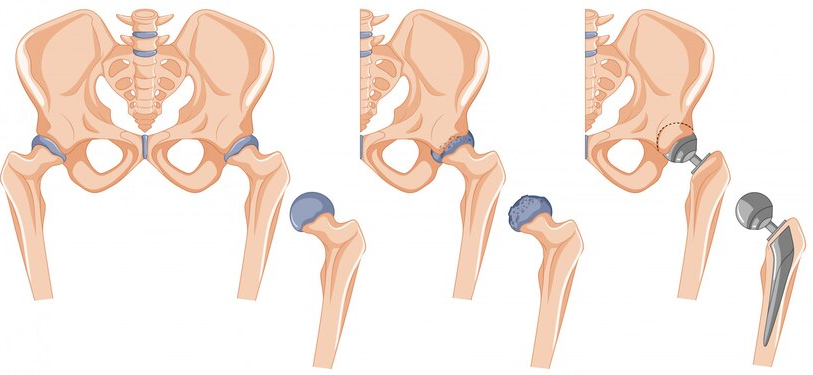
The left shows a normal hip joint, the middle a hip joint with degeneration of the joint surfaces (osteoarthritis), and the right a hip after replacement
Before we dive into how the procedure has improved, let’s first go over how the surgery is performed. To summarize it, the surgery’s goal is to replace the worn out surfaces of the hip’s ball and socket joint. The surgeon will clear out some of the damaged tissues and replace it with an artificial joint and surface, usually made of specialized plastic and metal. This synthetic cartilage allows the joint to move smoothly again.
How has the surgery changed over time?
We will split this section into 5 parts to examine different aspects of the surgery itself and surgery procedures that have evolved. Each of them contributes in its own way an accelerated healing process and better health outcomes.
1. Prehab vs traditional post-op rehab
Previously, treatment didn’t start until after the surgery had already been done, as it was thought that there was nothing that could be done besides surgery.
Now, we know that physiotherapy and pre-rehabilitation are essential leading up to and actually delaying surgery. Delaying is important as hip surgeries have to be revised eventually, we will get to this more in our next point. Physiotherapy starts weeks before the surgery to build up your strength and optimize your brain and muscle connection. This has been shown to ease the recovery process and return strength faster.
2. Lifespan of a hip replacement
Previously, patients were told to save the surgery for as long as possible, as the parts would wear out in 10-15 years. This revision surgery is not as effective as the primary surgery at reducing pain and increasing function and also will not last as long, leading to more revisions. This left people needing earlier replacements, such as their 50s, waiting with a lot of pain and disability.
Now, due to improvements in material engineering there has been a huge increase in durability. The Lancet estimated that hip replacements can now last around 25 years in a majority of patients.
3. The relaxing of hip precautions
Previously, patients were given very rigid rules to follow with their hips for 6-12 weeks after surgery to reduce the chance of dislocation. These included things like don’t cross your legs, don’t lift your leg past 90 degrees, don’t turn your toe inwards, sleep with a pillow between your legs and so on.
Now, research has shown that these precautions were overly restrictive and didn’t impact the risk of dislocation at all. In fact, it had a negative effect by creating a environment of anxiety around the hip, slowing down recovery. Some restrictions may still be recommended by your surgeon and depending on the technique used. In general, the rule of thumb is to listen to your body and move naturally.
4. Same day discharge
You may be using a cane or walker to help support the hip after the surgery.
Before, recovery times after a surgery included a couple day stay in the hospital before being allowed to walk.
Now, you are up on your feet within just a couple of hours after waking up from surgery. Total hip replacements are now considered an outpatient surgery, which means that you go home on the very same day that you had the procedure. Patients are told how to prepare their homes to make the transition easier, but resting in your own bed can’t be beat! What this also means is that Physiotherapy post-op rehab will take place outpatient now as well, and you are recommended to start ASAP.
5. Change in surgical techniques
Before, the traditional approach was to make an incision through the back of the hip. Unfortunately, this required the cutting through of some important stabilizing muscles like the glutes. This led to longer recovery times for these muscles and also the distinctive walking pattern where their hip will jut out every time they step on it, or the body leans over heavily.
Now, there are other techniques such as the anterior approach which allows the muscles to be spared. The surgeon does not have to cut through any muscles, they can just work around them. This results in a faster return to normal walking patterns, no precautions, and usually less pain as well.
Waiting for a surgery or have hip pain?
Look for PhysioNow! We have expert clinicians ready to assist you at any point during the process. Whether you are trying to prevent surgery, have a new hip pain, awaiting surgery, or are trying to schedule your post-op care, we can do it all! We have 10 clinics across the West GTA including Burlington, Oakville, Mississauga, and Etobicoke. We have free parking with accessible spots available, offer direct billing, and extended evening and Saturday hours for your convenience. Get your hip pain looked at today, book with PhysioNow today for your first assessment and treatment! Or contact us at P: 289-724-0448 or E-mail: applewood@physionow.ca for more information.