
Getting help from your back pain can feel very scary. Namely, words like x-rays, MRIs, surgery, disc bulges degeneration, and nerve impingement are extremely common when going to the doctor. It’s easy to get the wrong idea and feel like your issue can’t be solved, or is permanent. In Physiotherapy, we see people with imaging everyday, who have no clue what any of it means. In fact, it often makes them feel worse, and more scared to move. Today we want to clear up the misconceptions with disc bulges and what a realistic treatment program actually looks like.
What is a disc bulge/herniation?
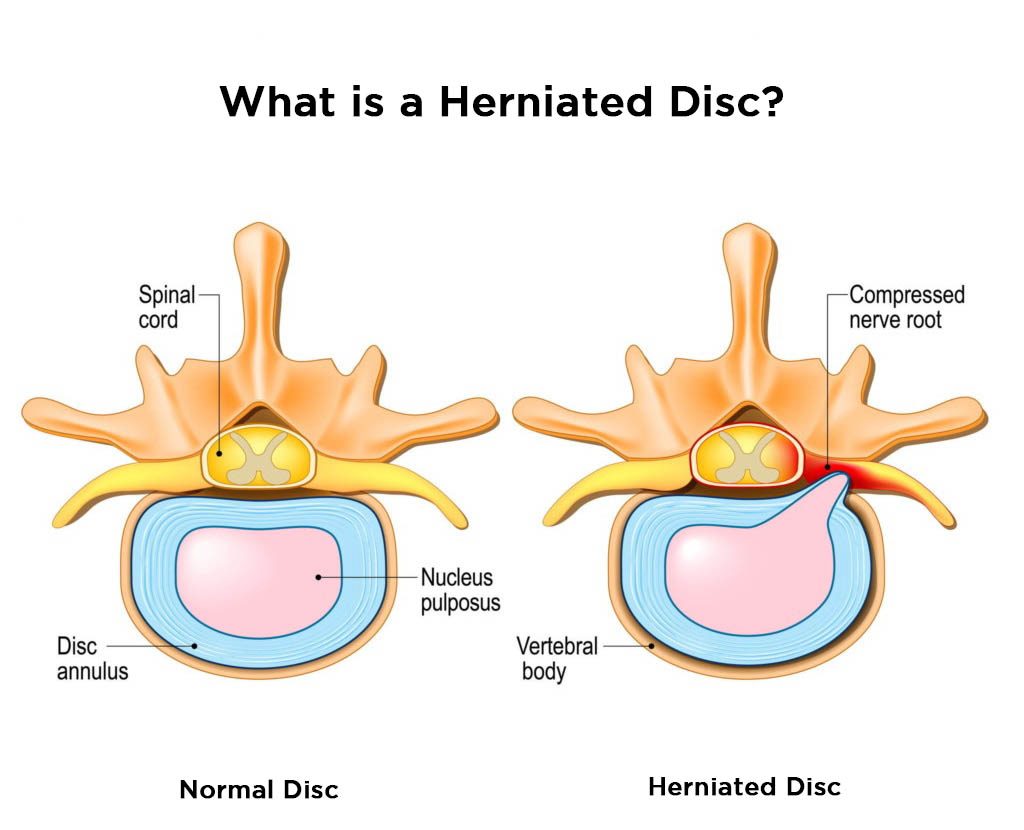
Let’s start from the beginning, what actually is a bulge? In between each of our vertebrae from the neck all the way down to the lower back, there are squishy discs that act as shock absorbers. They have a thick outer lining and a soft inner center that lets them perform shock absorption while remaining flexible. A herniation or bulge is when the inner center gets displaced and puts pressure on the outer ring, changing the shape of the disc overall. There are different classifications based on how exactly the material has moved but in general, it is enough to know that it is just a displacement, the discs do not actually slip out. They are firmly attached the whole time still to the bones.
What can I do or not do with a disc bulge?
In reality, the biggest barrier to a disc bulge is fear. There are actually many people who have current disc bulges, but feel no symptoms at all. In other words, if we took random people off the street and MRI’d their backs, we would find a proportion of them with all kinds of “positive” imaging, but feel no pain or symptoms at all. Ultimately, this means that imaging has a very poor correlation with how people actually feel, so we have to be mindful of how much we rely on imaging.
Common myths include:
- My MRI shows a bulge, I’m permanently damaged
- In reality many people are moving around, even playing sports, with disc bulges whether they know it or not. They become more likely to happen as we age, with normal wear and tear, but have no bearing on how we move.
- I can’t move until my back heals
- Prolonged rest is the complete opposite of how we treat people. Gentle, progressive movement with an initial focus on pain management, then strengthening is the gold standard for treatment. A Physiotherapist is your guide to how to navigate your back pain safely, and what to expect during this.
- I can’t lift heavy things anymore
- With proper treatment and Physiotherapy rehabilitation, many people return to any kind of high impact and intensity activities that you can think of. If you treat it like any other body part, a tear or injury is not the end, people recover from injuries all the time.
What are the signs and symptoms of a disc bulge?
Disc bulges can happen acutely, or develop over time. As some people can have a bulge with no pain, the severity and set of symptoms someone can experience vary greatly. The most common things are:
- Back pain that might radiate down the leg: Most people will have pain in the back, but may actually feel a referred pain anywhere down the arm or the leg, potentially right to the fingertips or toes
- Nerve pain: Sharp, electric, burning, stabbing paints that shoot down the arm or leg
- Sensory changes: Tingling and numbness down the arm or leg
- Muscle weakness: Fatigue or heaviness in a certain movement or limb
- Pain with increased abdominal pressure: Often coughing, sneezing, or when bracing the core
Do I need surgery or physiotherapy?

Surgery is the last resort for most individuals except in certain rare occasions. Most individuals are started on a conservative management program with Physiotherapy and recover well through that. We’ll start with how physiotherapy manages pain, and when that fails or in those special cases, where surgery plays a role. It is worth noting that the vast majority of individuals with back pain from disc bulges do NOT require surgery and recovery completely without it.
How does physio help?
- Education: One of the most important things is understanding the do’s and dont’s, expected response to treatment, and addressing excessive fears and. Understanding how much you can do and what you can do to allow the disc to heal while optimizing your own movement
- Pain management: Your physiotherapist can perform manual therapy techniques, stretches, mobilizations, and use modalities like electrotherapy to help you minimize pain
- Load management: When deemed appropriate, your physiotherapist will help you return to lifting and daily tasks safely, then eventually physical activity and sports
- Home exercise programs: This includes specialized exercises to reduce back pain, core strengthening, general full body strengthening, stretches and more
Who gets surgery?
Like previously stated, the vast majority of disc herniations even if they’re serious, can be resolved with 6-12 weeks of Physiotherapy. The individuals who would be considered for surgery are:
- Cauda Equina syndrome: This is a medical emergency resulting in compression of the nerves at the end of the spinal cord. It presents as a loss of bowel/bladder control, saddle anesthesia (numbness in the area that would touch the saddle), significant leg weakness/pain that is progressing
- Progressive neurological symptoms: This means that nerve damage is occurring, resulting in increasing muscle weakness
- Life-limiting pain: If the pain is so severe that basic quality of life is affected after an attempt with conservative care has failed
Looking for more information on low back pain or disc bulges?
Then look for PhysioNow! Disc bulges are common occurences that are reversible, not permanent disabilities. With help from Physiotherapy you can return to your normal life. PhysioNow has expert clinicians at 10 locations across the West GTA including Burlington, Oakville, Mississauga and Etobicoke. Book with PhysioNow today for your first assessment and treatment! Contact us at P: 289-724-0448 or Email: applewood@physionow.ca. We’d love to hear from you and answer all your questions.